Project
S-PLUS Clusters and Large-scale Environments
A project exploiting S-PLUS multi-band photometry to investigate the large-scale structure of the Universe.
0 publications Project site
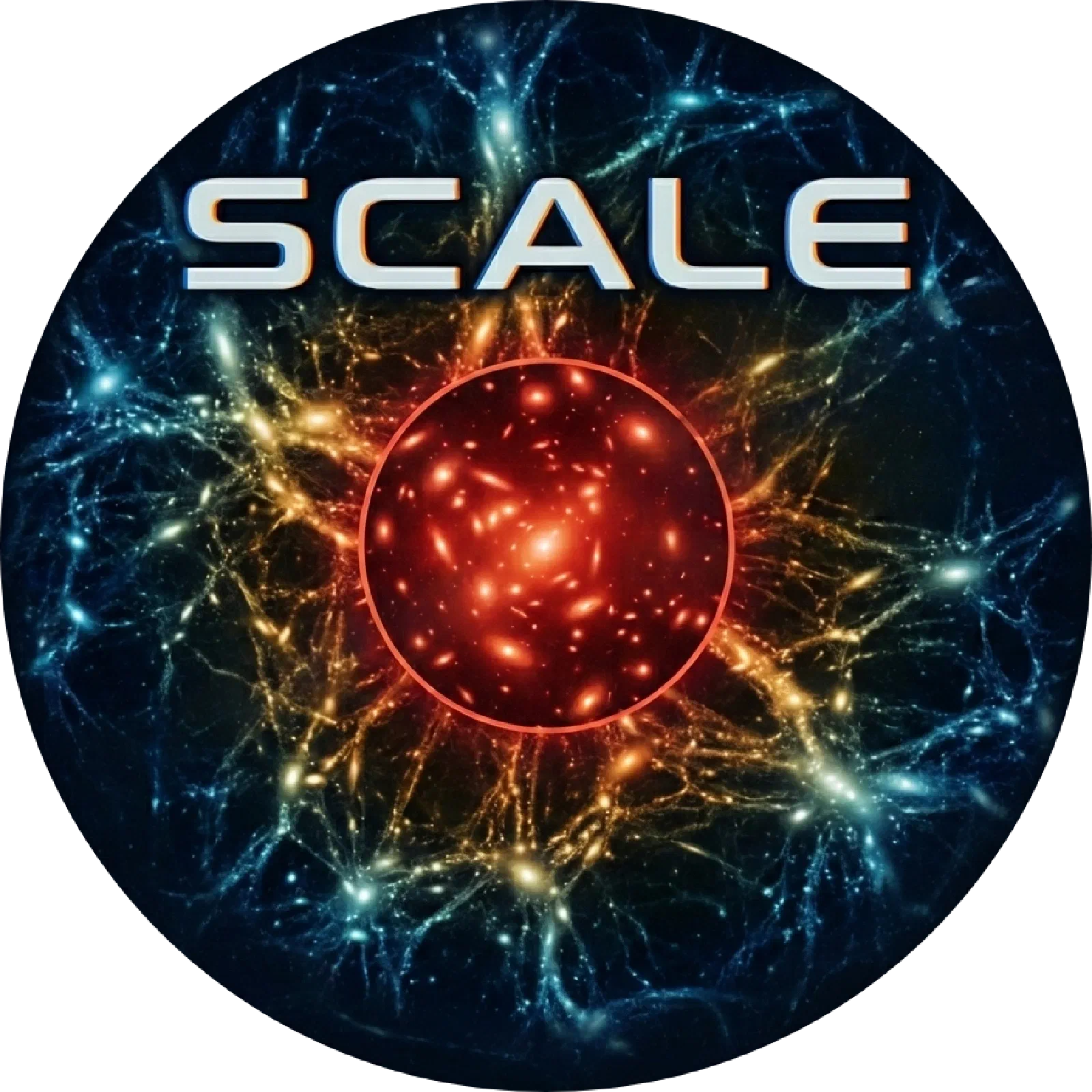
The S-PLUS Clusters and Large-scale Environments (SCALE) project is focused on exploiting the S-PLUS data set for cosmological and extragalactic studies based on the statistical distribution of galaxies and other tracers across the sky. Its scientific case is rooted in the use of the survey’s large-area, homogeneous 12-band photometry to construct well-characterized samples suitable for investigating the connection between galaxy populations and the underlying large-scale structure. The additional spectral information supplied by the narrow bands is particularly valuable for improving object characterization and deriving redshift- and population-dependent quantities from photometric data.
A major objective of SCALE is to transform the rich photometric information of S-PLUS into cosmologically useful observables and catalogues. This includes the characterization of galaxy samples, photometric-redshift information, selection functions, and physical properties that are required to robustly measure large-scale structure and its evolution. By combining wide-area coverage with enhanced spectral sampling, SCALE can explore regimes in which purely broad-band surveys face stronger degeneracies, thereby improving the identification and characterization of the tracers used in statistical cosmological analyses.
The scientific novelty of SCALE arises from applying a filter system intermediate between conventional broad-band imaging and spectroscopy to large-scale cosmological investigations. S-PLUS therefore offers the possibility of increasing the information content available per object while preserving the survey efficiency necessary for population-level measurements. In this context, SCALE provides an important testbed for methodologies that combine multi-band photometry, statistical inference, and modern data-driven techniques, while also establishing a path toward maximizing the cosmological return of current and future photometric surveys.