Project
S-PLUS Fornax
A multi-band investigation of the Fornax galaxy cluster aimed at understanding galaxy evolution across diverse environments.
0 publications
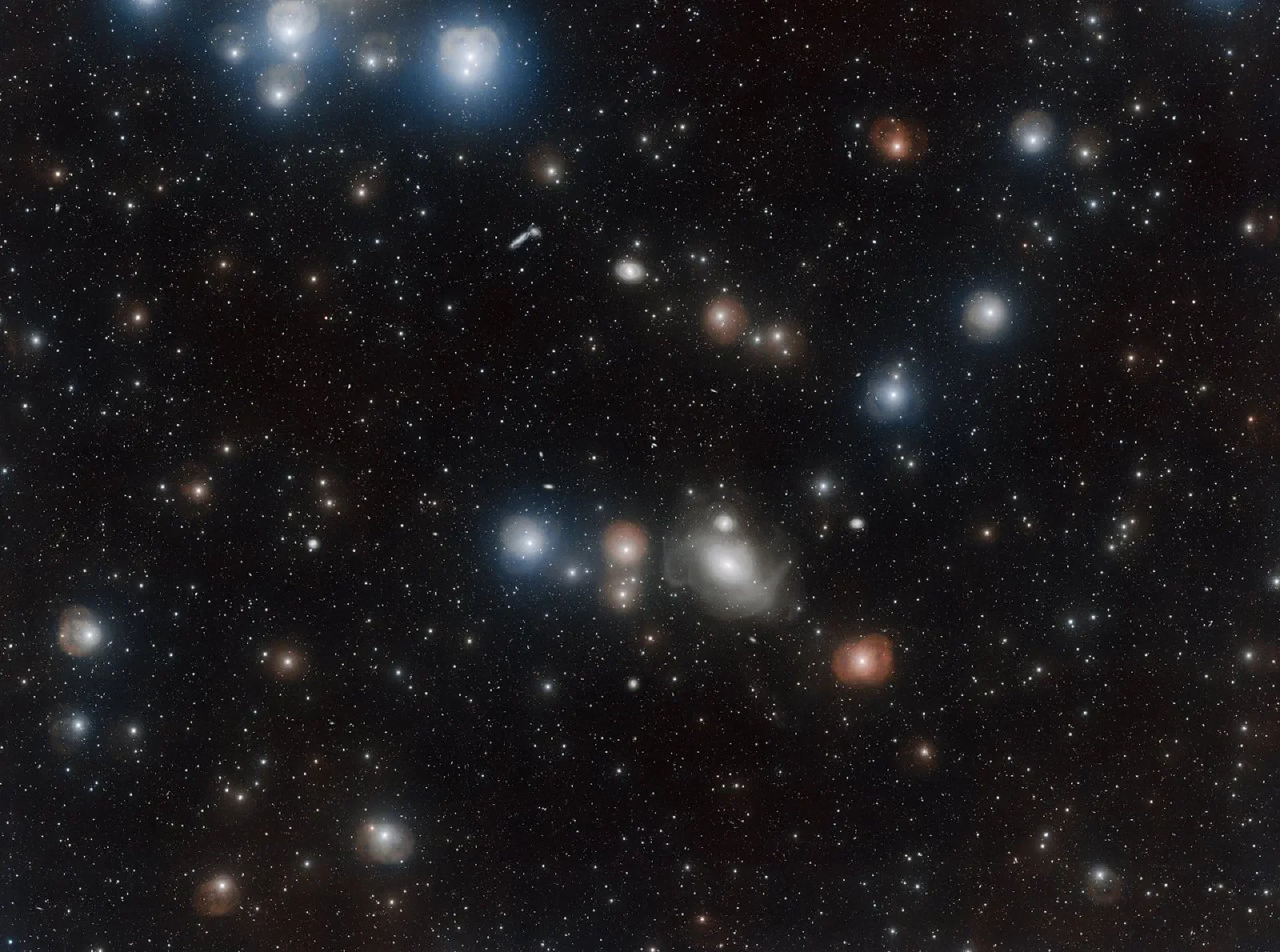
The Fornax Galaxy Cluster. Credit: the VLT Survey Telescope and European Southern Observatory (ESO).
The S-PLUS Fornax (S+F) project exploits the 12-band imaging capabilities of S-PLUS to investigate the Fornax galaxy cluster and its surrounding environment. As one of the nearest and best-studied galaxy clusters, Fornax provides an exceptional laboratory for examining the role of environment in galaxy evolution across a broad range of masses and morphological types. The project combines the statistical power and homogeneous photometric coverage of S-PLUS with the cluster’s extensive ancillary data to study its galaxy population and spatial structure over scales extending beyond the cluster core.
A central scientific motivation of S+F is to characterize how galaxy properties vary as a function of environment and cluster membership. The multi-band SED information provided by S-PLUS enables the investigation of stellar populations, star-formation activity, colours, and emission-line signatures for large samples, including low-luminosity systems that are particularly important for understanding the assembly and transformation of galaxies in dense environments. The wide-field coverage also permits the analysis of the transition between the cluster core, infall regions, and the surrounding large-scale structure.
The novelty of S+F lies in using a homogeneous narrow- and broad-band photometric data set to investigate a nearby galaxy cluster continuously across multiple environmental regimes. This approach complements targeted spectroscopy by extending the analysis to substantially larger and more complete photometric samples while retaining sensitivity to relevant spectral features. Consequently, S+F provides a framework for connecting resolved environmental studies in the local Universe with the large statistical samples expected from current and forthcoming multi-band surveys.